Sir Robert Ker Porter (1777–1842) was a Scottish traveler, writer and diplomat. Born in Durham, he pursued his passion for drawing at the Royal Academy and won a number of prizes for his earlier works. With the start of the Napoleonic Wars, Ker Porter traveled across Europe, visiting Sweden, Finland and Russia in 1804-1805 and later travelling to Portugal and Spain in 1810-1811. By 1812, he was back in Russia (where he married a Russian princess) and wrote his account of Napoleon's invasion of Russia. returning to Britain in 1813, he again traveled to the Russian Empire in 1817. He spent next three years visiting southern Russian provinces, Caucasus (Georgia and Armenia) and Iran. The result of these travels was his new book "Travels in Georgia, Persia, Armenia, Ancient Babylonia, 1817–1820" published in London in 1821. Ker Porter recorded many interesting observations about Georgia, its nature and people. One of his passages dealt with the Georgian clothing:
During my stay at Tiflis, the weather, which was almost one continued rain, proved very unfavourable to my wish of penetrating any depth into the fine province of Kakhetia, the celebrated Albania of the ancients. However, what I did see, more than answered the images impressed on my imagination, by the representations I had received of the abundant beauties of its valleys. The hills, and even mountains are clothed with the finest woods, consisting of oak, ash, chestnut, beech, and elm, intermixed with a thousand peculiarly favoured spots (as if the benign spirits of these more genial regions had here planted their own little secret gardens) producing the most delicious grapes, though wild, and fruits of the choicest flavour. The wines, both red and white, which are made from these natural vineyards, have always been esteemed for softness, lightness and delicacy of taste, beyond those of any other district in the province of Georgia.
The valleys of Kakhetia are abundant in hemp, flax, rice, millet, barley, and wheat; and with so little trouble to the occupier of the. soil, it might almost be said, they grow spontaneously. Pheasants, wild fowl of every kind, antelopes, and deer, sheep, and all sorts of domestic cattle, enrich these luxuriantly-pastured vales. The rivers, too, add their tribute of plenty to the ample stores of nature. And, to wind up the climax of such a prodigality of blessings, (for all the treasures of the mineral world may be found in the hearts of its mountains,) the climate is delightful. Indeed, heaven seems to have drawn to this happy spot the essence of all that is necessary to the wants of man.
But, alas! the man, which has been placed in this earthly paradise, to keep, to dress, and to enjoy it, has neither the will to separate the weed from the good herb, nor the taste to feel that it is sweeter than his neighbour’s. Sunk in apathy, he cares not whether rain or sunshine descend on the ground; abandoned to indolence, it is all one to him, whether his food be the bramble [rough prickly shrub] or the grape; and, for personal comfort, the stye would afford as pleasant a pillow as a bed of flowers: such is the present Kakhetian!
But, that so strange a contrast between the man and the soil, is not always the effect of any natural cause, such as climate, &c. may be affirmed, from what was the character of the Albanian inhabitant of this very same district.
Dr. Beniggs, who resided for a considerable time in Georgia. during the reign of the unfortunate Heraclius [King Erekle II, d. 1798], writes thus of the general Georgian character at that time, which, of course, includes the Kakhetians, their country being a province of Georgia. And in the reasons he gives for the moral defects he describes, we find the cause why the later natives of Kakhetia differ so essentially from its earlier people, when the same country bore the name of Albania. He observes, "that both the nobles and peasantry of Georgia are given up to a wretched degree of sloth, appearing to despise all laudable pursuits which require attention or labour ; and, amongst others, the cultivation of the earth. But this stubbornv indolence is not the natural bias of the Georgian. He is fully aware of his wants, of his miserable poverty, and of the usual means of relieving such a state; but he has no hope, in applying, to the resources apparently open to his industry. Oppression is at the door to weigh down his efforts, or rapacity at hand to seize the product of his labours. He is under the eye, and the hand, and the double yoke, first of his own chiefs, and then of the powers beyond them, till the burden becomes too heavy to be borne erect, and the man falls prostrate, a wretched, useless slave. Thus avarice set bounds to its own extortion, by damming up the sources whence it flows.”
Constant feuds amongst the [Georgian] chiefs themselves, rendered desperate by the total absence of all law or justice; the inroads of the Lesghees, and bloody wars with the Turks and Persians; all combined to drive the great mass of the people into that state of utter despair, which gradually subsides into the sullen contentedness of sloth, ignorance, and poverty. This must be the universal situation of every country which has been, for any time, under the subjection, or rather mis-rule, of a ceaseless change of masters; some absolutely barbarians, and others, who have yet to learn the science of government from Christian laws: and this was the situation of Georgia for a sad succession of times. But, about twenty years ago, it was received within the lines of the Russian empire, and the happy effects on the minds of the people, in feeling themselves under a regular government, secure in its natural strength, and dispensing that security to its appendages, are already become very apparent. Every encouragement to industry is held out to them; and none has more persuasion than the laws, which protect men in the possession of the fruits of their labours. The different European governors, who have been put at the head of affairs here, since the junction of the province with Russia, have done all in their power to conciliate both nobles and people, by the administration of an equal justice, and a gradual amelioration of all those circumstances which had so long, disorganised, and rendered poor, savage, and miserable, all ranks of persons. Being now effectually guarded from the inroads of the Lesghees, or the more overwhelming incursions of Turks and Persians, the higher orders begin to feel again that they hold a station in their country; and to establish the re-awakened sense in their own minds, and in the respect of the people at large.
His Imperial Majesty [Russian Emperor Alexander I] has conferred orders and medals of distinction on many of the native nobility, with titles and commissions of military rank; and, in short, every other excitement to the restoration, or rather civilisation, of the country, that can be offered by a generous sovereign to a brave and confiding people. That they are still brave, when they have any thing beyond mere animal existence to defend, has been made manifest during the last twelve or fourteen years. In the wars of that period, they engaged heart and hand under the banners of Russia; and their chiefs so distinguished themselves, that many rose to the rank of generals; still continuing the brave acts by which their new honours were won. Indeed, it is very evident how much easier their new government finds it to arouse the old spirit of Iberian and Albanian courage, in the bosoms of their Georgian descendants, than to inspire them with one for traffic and agriculture. But all will succeed in time; and their neighbours, the Armenians, set a stimulating example of the ways and means of industry, and show many persuasive advantages, resulting from their extensive exercise.
[...]
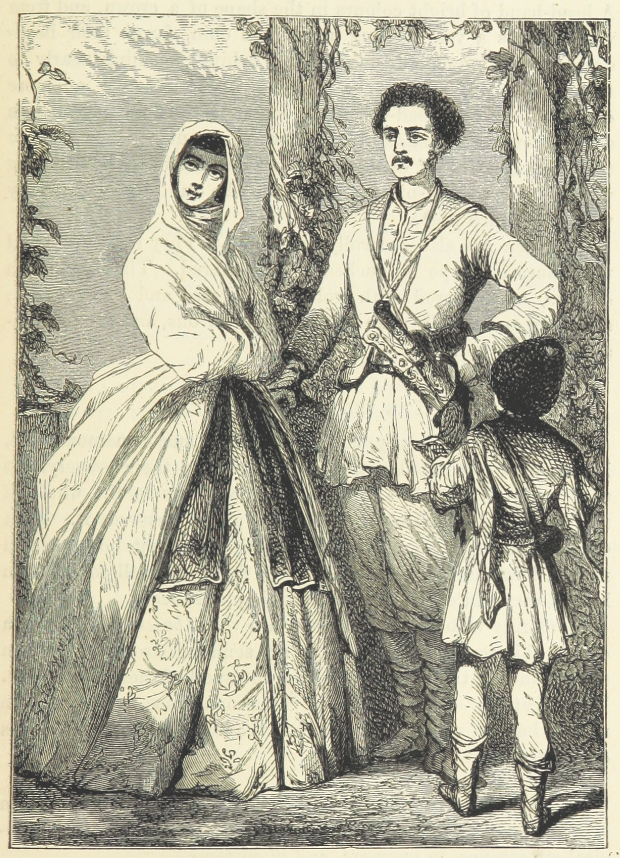
One evening, at an entertainment given by His Excellency the Governor-General [Alexei Yermolov], I had an opportunity of seeing, not only a great many of the native nobility of both sexes, but also persons of consequence from other of the Caucasian countries. The Georgian noble is particularly distinguishable by the sombre cast of visage, above described; but though so stern, it is of a fine contour, and harmonizes with the manliness of his figure and style of dress. The latter is admirably calculated for freedom of motion, and therefore cannot but show the person to advantage. It chiefly consists, first of an under garment of fine pink cloth, worn as a shirt, and discoverable by the opening of the vest at the bosom, but only as far up as the bottom of the throat, the neck being entirely bare. The vest, which is cloth also, of a different colour from the shirt, has sleeves to it, sitting easy to the arm; and over this is the tunic or upper garment, coming'down as low as the knees, but opening before; and bound round the waist with a cloth sash, universally white, to which is attached the wearer’s sword. The skirt of the tunic meets the termination of the full short trouser or breeches, which descend no lower than the knees; the leg being covered with a sort of stocking, and a close-laced half-boot, usually black or scarlet, with a very pointed toe.
All these various garments are of cloth, of as various hues; and, frequently, very handsomely ornamented with gold lace or embroidery. Mustachios on the upper lip, with some appearance of dark curling hair in the pole of the neck, from under the high black sheep-skin cap on his head, complete the dress of a Georgian gentleman. This cap is, in form and materials, the same with that in use all- over Persia; only, the Georgian "wears his with a difference;" not striking it down into a sort of bi-forked shape at the top, when putting it on, but keeping it quite erect, in its original rounded pyramidal form.
The costume of the lower ranks, is marked by long trousers, reaching to the ankles, made of an inferior kind of silk; a dagger (or kanjar) in place of a sword, hanging to the girdle ; but the rest of the raiment [clothing], being of the same fashion with the chief’s, is also of the same materials; cloth, though of a coarser quality, and without decoration.
The dresses of the Georgian ladies bear a full proportion, in point of cumbersomeness and ornament, to the beauty they overload, in attempting to adorn it. A bandeau, round the forehead, richly set with brilliants and other costly stones, confines a couple of black tresses, which hang down on each side of a face, beautiful by nature, as its features testify, but so cased in enamel, that not a trace of its original texture can be seen ; and, what is worse, the surface is rendered so stiff, by its painted exterior, that not a line shows a particle of animation, excepting the eyes ; which are large, dark, liquid, and full of a mild lustre, rendered in the highest degree lovely, by the shade of long black lashes, and the regularity of the arched eye-brow. A silken shawl-like veil depends from the bandeau, flowing, off the shoulders, down the back; while a thin gauze handkerchief, is fastened beneath the chin, binding the lower part of the face, and descending as low as the bosom, where it ties over the rest of the garments; showing, through its light medium, the golden necklaces and other jewelry which decorate the vest. This latter piece of raiment is usually made of velvet, or silk richly embroidered, covering the bosom and entire waist. A close gown of brocade, with sleeves to the wrist, and an exceedingly long skirt, devolving on the ground all round, is put over the vest; but left open in front, as far as the bottom of the waist. The whole is then confined, with a fine Kashmere shawl. The sleeves of the gown are open in front of the arm, but closed at pleasure by little pineapple-shaped gold buttons and loops. Over all this, in cold weather (which was the season in which I saw these ladies) is added the oimah, or short pelisse, of gold brocade lined with fur: it flows loose to the figure, with wide sleeves; is open in front, reaching only a little below the knees; and has a superb, as well as comfortable appearance. However, when the fair Georgians sit or stand together, in this gorgeous apparel, the inflexible stiffness of their position, and_total absence of motion in features or complexion, give them the effect, rather of large waxen images, which open and shut their eyes by mechanical ingenuity, than that of living, breathing, lovely women.
[...]
In the course of the evening, at His Excellency’s, some of the Georgian young men of rank were prevailed on to show us a specimen of their national dance; but none of the ladies could be induced to take a part in it.
[...]
The Georgian dance, to which I was then a spectator, consisted of feats of activity, and many strange, and far from elegant, contortions of the limbs; such as twisting one leg over the other, knocking the knees together, and hopping along on their bunkers; but, I fear, the generality of my readers will not understand that provincial word of the north of England; it is, however, the only one which occurs to me, descriptive of the grotesque action, which happens to be, also, a sport amongst children, of the lower orders, in our northern counties; and it is done, by sitting down on their heels, and hopping about in that position. The Georgians, after several other bodily freaks of the kind, completed their exploits by capering on their toes. To give a proper spirit to the performers, the national music had been procured, which bore an equal rank in points of civilisation and elegance with the graces it was to inspire. However, it seemed to animate the motions of the brave inhabitants of Caucasus, in like manner with the influence of the bag-pipe on the vigorous limbs of our own gallant Highlanders; for feet, hands, and head, all moved in active response to the strains of their native Orpheuses. The instruments, and the strains, are difficult to describe; but I make the attempt in saying that the first consisted of an assemblage of small double-drums, in shape and size not much larger than a couple of slop-basons united; these were beat continually in concert with five or six instruments in the form of guitars, played upon with a bow. Their harsh scrapings, mingling incessantly with the monotonous thumping of the drums, sent forth a noise [that] I could only compare to that of a water-mill, without its harmony.