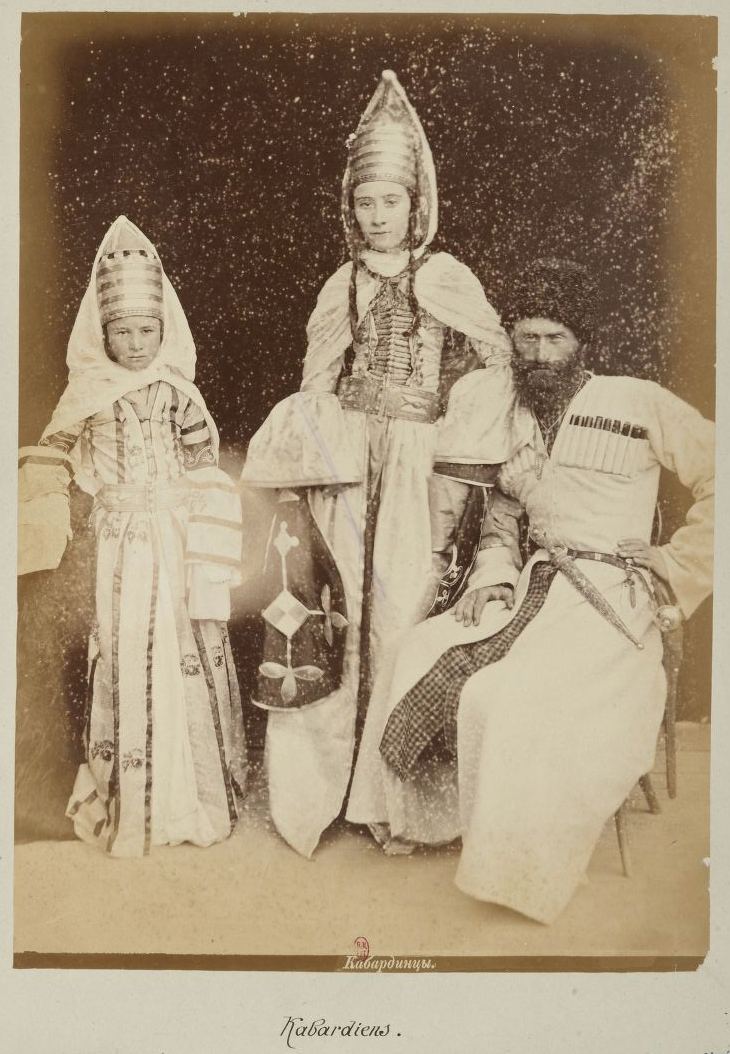
In the early 1870s, the French publishing house Hachette decided to published a multi-volume reference work on cultural geography of the world, a pioneering idea of the famous French geographer Elisée Reclus. Entitled Nouvelle géographie universelle: La Terre et les Hommes, it took Reclus eighteen longs years (1876-1894) to complete his magna opus of nineteen volumes, each devoted to a particular region of the world and containing detailed essays on land and peoples of that part of the world. The book was widely acclaimed and was translated in several languages, including English. In 1892 Reclus was awarded the prestigious Gold Medal of the Paris Geographical Society for this work.
 Volume six of Nouvelle géographie universelle, which was published in 1881, dealt with "L'Asie Russe" (Russian Asia) where Reclus included a vast area from the Caucasus to Central Asia and Siberia. In the chapter on the Caucasus, the author provided geographic overview of North and South Caucasia and described peoples residing there. While working on this chapter, Reclus solicited a wide range of materials on Georgia some of which was provided by Georgian writer Iona Meunargia.
The chapter included many illustrations that were drawn from life or based on photographs taken in the region. Below are the excerpts and illustrations pertaining to Georgia:
The Svans and Rachians
The natives themselves are far from being a pure race. Amidst a great variety of types the contrast presented by the fair and brown Mingrelians is very striking. The former are distinguished by a lofty brow and oval face, the latter by broad features and low forehead, though both are alike handsome and of graceful carriage. From the remotest times the eastern shores of the Euxine have been visited by friends and foes of every race, many of whom must have introduced fresh ethnical elements. Arabs, and even negroes, flying from their Turkish masters, have contributed to increase the confusion. Yet, however numerous were the crossings, all have become blended together, jointly tending to develop the beauty of the original type.
In the Mingrelian lowlands, and especially on the advanced spurs up to an altitude of about 3,700 feet, nearly all the men are handsome. But in the heart of the highlands, where the struggle for existence becomes more intensified, the features, especially of the women, are often even ugly. Goitre [a swelling of the neck or larynx resulting from enlargement of the thyroid gland] and cretinism [a condition of severely stunted physical and mental growth due to untreated congenital deficiency of thyroid hormones] are frequent amongst the Svans, and as we ascend the Ingur from the region of maize to the snowy pastures, the change in the appearance of the inhabitants is analogous to that which is observed by the traveller passing from the Italian lakes to the Alpine gorges of the Valais.
 |
| The Svans |
The Svans, who occupy the Upper Ingur and Tskhenis valleys, are evidently a mixed race, although fundamentally akin to the Georgians, to whom they are also allied in speech. They were formerly a powerful nation mentioned by Strabo, and in the fifteenth century they still held the Upper Rion valley. The present survivors seem to descend mainly from fugitives driven from the Mingrelian plains by oppression and the calamities of war. In the secluded valleys bordering on the glaciers they found a secure retreat, almost severed by physical barriers from the rest of the world. More accessible are those of the Upper Tskhenis basin, who have consequently had to endure the hardest feudal rule under princes binding them to the glebe. This branch take the name of Dadian Svans, from the ancient Georgian princely title of "Dadian" assumed by the governing family. They are scarcely to be distinguished from their Imeritian neighbors, and their speech is a pure Georgian dialect. The Dadishkalian Svans, in the western division of the Upper Ingur basin, are also under a feudal lord of Kumik Tatar stock; but being regarded as serfs, they were emancipated at the expense of the Russian Government when serfdom was everywhere officially abolished. The eastern communities of the Upper Ingur have long maintained their independence, and are still often distinguished by the epithet of "Free," although they took the oath of obedience to Russia in 1853. And in many respects they are still really free, recognizing neither lord nor master, and rejecting even the control of the clergy. In the communal gatherings all have an equal voice, and important decisions require to be adopted unanimously, the opposition of a single member causing the whole question to be postponed until unanimity can be secured. Nor does the commune interfere in personal quarrels, which are regulated by the lex talionis [law of retaliation]. Nowhere else in the Caucasus are the laws of vendetta more rigorously adhered to, so that few are met who have not killed their man. All the houses along the Upper Ingur are real fortresses, perched on rocky eminences, and commanded by square watch-towers 60 to 80 feet high. The doors of these keeps are on the second or third story, and can be approached only by rude ladders formed of the stems of trees.
Hereditary animosities greatly contribute to the reduction of the population pent up in the bleak valley of Free Svania, or Jabe-Shevi; yet it is still so dense that the people are obliged to emigrate to the neighboring tribes. In the days of their military power their young men left their homes as conquerors, often undertaking plundering expeditions to the plains, and even in the fourteenth century they were strong enough to burn the city of Kutais. Till recently the excessive population was also checked by the practice of infanticide, in which most of the girls perished, while in hard times grown-up children were sold at prices varying from 700 to 1200 francs. The small amount of trade carried on by the tribes lower down is monopolized by the Jews, who are grouped in the village of Lakhamuli. These Jews are distinguished from their brethren elsewhere by their warlike habits. But although practicing Christian rites and calling themselves Svans, the hillmen of the Upper Ingur contract no alliances with them, and even refuse to eat at their table.
All the Svans, estimated at over 12,000, are classed amongst the Christian tribes of Caucasia, and even claim a sort of pre-eminence amongst their co-religionists, pretending that their ancestry were baptized by Christ himself. But their Christianity has been developed in a somewhat original manner under the influence of older rites. Thus their little chapels, large enough to accommodate about a dozen, have crypts filled with the horns of the chamois and wild goat, which are objects of great veneration. The priests, or "papas," form a distinct hereditary caste, though their only privilege is exemption from the laws of vendetta. Although not obliged to keep the lower part of the face covered, the women pass a bandage over their mouths when singing national or religious songs, possibly to prevent the devil from entering. All the Svans are also bound to silence when on the march, or chanting sacred hymns, for the least word might draw down the tempest. Analogous superstitions occur amongst the Norwegian fishermen, the Buriats, and the American hunting tribes.
The district of Racha, comprising the Upper Rion valley, is larger and more populous than the western basins of the Tskhenis and Ingur, and has always offered a route to graziers, traders, and even warlike bands crossing the Caucasus obliquely from the Georgian to the Terek lowlands. Hence the Rachians, who, like most of the people in the government of Kutais, are of Georgian race and speech, are more civilized than their Svanian neighbors. But they also are too numerous for their largely unproductive territory, so that thousands are forced to emigrate to the lowlands, seldom returning without having amassed a small fortune. Most of the carpenters and sawyers met with in Imeria and Mingrelia are Rachians.
The Imeritians, Mingrelians, and Lazes
The Georgians of the Upper Rion basin bear the general name of Imeritians, or more properly Imerians; that is, "People of the other side," in reference to the Suram Mountains separating them from the bulk of the nation. The term Imereth, or Imeria, has been applied, with the shifting of the border peoples, at times to all Western Transcaucasia, at times only to its upper section, Mingrelia being usually reserved for the low-lying region comprising the alluvial lands and coast district.
Thanks to their damp, miasmatic, and enervating climate, the Mingrelians are mostly of an indolent temperament, while their brethren who have migrated to the dry district of Tiflis are noted for their active habits. A repugnance to labour was also naturally fostered by former devastating inroads, incessant intestine warfare, and the complete thralldom of the peasantry to their nobles. Here was represented every variety of serfdom, and until 1841 the priests themselves were classed as serfs. Even in recent times the Mingrelian princes were accustomed to apply personally for their tribute. Followed by courtiers, retainers, falconers, dogs, and horses, they would swoop down on some unfortunate vassal, living at his expense as long as the provisions lasted, then betaking themselves elsewhere, and thus making a round of revelry as self-invited guests, and leaving ruin in their wake. No women, especially if well favoured, were safe from these despots, who carried them off and sold their children into slavery.
Although generally too weak to resist, the Mingrelians were nevertheless occasionally driven by this oppression into revolt, as in 1857 and 1858, when they appealed to arms for the recovery of their captured women, and to get rid of the yoke riveted by their masters round their necks. But all such efforts were quenched in blood, nor was serfdom finally abolished till three years after its suppression in the rest of the empire. But many of its effects still remain, and in a teeming land the Imerians and Mingrelians continue, like the wretched Lombard peasantry, to live almost exclusively on a mess of maize or millet resembling the polenta of Italy. The usual dress is a tattered smock fastened by a cord or strap to the waist, and instead of a hat a bit of cloth retained on the head by a string passed under the chin. The Mingrelian farmstead consists of a wretched hovel of wood or branches, surrounded by badly cultivated maize-fields, with a few lean pigs or goats, and one or two buffaloes wallowing in the muddy pools.
 |
| The Mingrelians |
Although till recently dwelling beyond the political limits of Russian Transcaucasia, the Lazes of the Ajara and Chorukh basins are none the less akin in speech and race to the Mingrelians and Georgians. Those still subject to Turkey, and reaching westwards beyond Trebizond, are also of the same stock, though more or less mixed with other elements, while beyond these limits many geographical names show that in remote times the interior of Asia Minor was largely peopled by Georgians. Rosen has established the near relationship of the Laz and Georgian tongues. The language current on the banks of the Chorukh differs little from Mingrelian, though that of the west coast is largely affected by Turkish and Greek elements. In their customs also the Lazes resemble the Imerians. Both respect old age, are extremely hospitable, and, while full of curiosity, still maintain a dignified reserve. Like most Caucasians, they are fond of display and rich attire, nor do they deserve the charge of indolence brought against them by careless observers, for their fields are well tilled and their houses kept in good order. The Laz women combine with beauty and symmetry of form a rare reputation for courage. The Moslem Lazes have emigrated in large numbers to Turkish territory since the annexation to Russia in 1878, while the Christians will now probably find their way to Tiflis and the Russian ports on the Euxine.
 |
| The Imeretians dancing |
The national character could scarcely fail to be modified under the Turkish regime. Three centuries ago all the Lazes of the Upper Ajara valleys were Christians, and many villages still boast of well-preserved churches in the best Byzantine style of architecture. Certain communes did not conform- to the Moslem creed till about the close of the eighteenth century, and several, though nominally followers of the Prophet, are still practically Christian, the two faiths often overlapping to such an extent that it becomes difficult to say where the one ceases and the other begins. With their religion the Turks also introduced their language into all the towns and large villages, so that the Laz dialect ceased to be current except in the remote rural districts. The Armenian colonies scattered over the land had also forgotten their mother tongue in favour of Turkish, which must now in its turn slowly yield to Russian, just as the Mohammedan must give way to the Christian faith.
The Georgians
In Central as in Western Caucasia the most numerous race are the Georgians, or Karthvelians, descendants of the Iberians spoken of by Strabo. The statuettes found in the graves represent exactly the same type and the same style of head-dress as those of the present inhabitants, so that no change has taken place in this respect during the last two thousand years. Masters of the land from the remotest historic times, the Georgians have succeeded, if not in maintaining their independence, at least in preserving their ethnical cohesion and various national idioms. They formerly occupied a wider domain, and although encroached upon at various times by Persians, Medes, Armenians, Mongols, Turks, and now by the Slavs, their territory still stretches from the plains of the Kura to Trebizond, and from Mount Elbruz to Mount Arsiani. Of all the Caucasian peoples the Georgians, who are estimated at upwards of a million, form the most compact and homogeneous nationality. In Georgia is situated Tiflis, capital of all Transcaucasia.
[...]
The Georgians of the Kura basin, like their Imerian, Mingrelian, and Laz kindred, fully deserve the reputation for physical beauty which they enjoy. They have the same abundant black hair, large eyes, white teeth, delicate complexion, lithe figures, small hands, that distinguish their western neighbours. Yet the appearance especially of their women, who mostly paint, can scarcely be described as prepossessing. They are cold and unattractive, their features lacking the animated expression and bright smile which intellectual development might be expected to have produced.
Most of the Georgians have a high, almost flushed complexion, due doubtless to excessive indulgence in wine, of which they are ever ready to take copious draughts in honour of their friends, generally with the Tatar words, Allah Verdi, "the gift of God!" The Kakhetians especially, proud of their excellent vintages, consume large quantities, and before the ravages of the oidium [fungus], the usual allowance of the field labourers was here about half a gallon daily. This fiery wine, some of which might compare favourably with the best produced in Europe, is mostly consumed in the country, and one of the most familiar sights in Kakhetia is the well-filled ox or pig skins hanging at the doors of the shops, or crossing the country in waggon-loads. In order to preserve the pliancy of the skins the natives have the horrible practice of flaying the beasts alive, and then smearing the hides with naphtha. This imparts a disagreeable flavour to the liquor, to which, however, even strangers soon get accustomed.
Notwithstanding the fertility of the land and relatively sparse population, the peasantry of the Kura basin are generally poor, owning little beyond a few mangy cattle and sheep, whose wool looks almost like hair. Like the Mingrelians and Imerians, though to a less extent, the Georgians have suffered from the feudal system. However, since 1864 and 1866 they have at least ceased to be attached to the glebe, and serfdom has been abolished in Transcaucasia, as elsewhere throughout the empire. But the nobles, who have remained large proprietors, have not all of them yet lost the habit of treating the peasantry as beasts of burden, while practices begotten of slavery in the people themselves have not yet disappeared.
They are for the most part uncleanly and listless, though their naturally cheerful, social, and upright disposition is gradually asserting itself. They are said to be rather less intelligent than the Caucasian races, and in the schools show less quickness than their Tatar and Armenian neighbours in mastering foreign languages and the sciences, though this may be partly due to the fact that the latter are mainly townsfolk, while the former are a rural population.
Theft is a crime almost unknown in the Georgian and Armenian communities, the few cases of larceny that come before the Tiflis courts being mostly committed by strangers. At the same time many are addicted to contraband habits. Nor does their national legislator, King Vakhtang, seem to have entertained any high opinion of their general uprightness. "I have drawn up this code," he writes, "but in Georgia no just sentence has ever yet been, nor ever will be, pronounced." Yet, however barbarous may have been the former Government, it remained for the Russians to introduce corporal punishment of the most degrading form.
 |
| Georgians |
One of the most remarkable traits of the Georgian race is their love of song and the dance. They have no great musical talent, and their language, with its numerous gutturals and sibilants, is scarcely adapted to melody. Yet none the less do they keep up an incessant chant all day long, accompanying themselves with the daira, or tambourine, and the balalaika, a sort of three-stringed guitar. Some will, so to say, adapt every movement to musical rhythm, and while weeding their maize-fields or engaged in other field work, the men dispose themselves in groups, singing in various sets snatches of verse suitable to the work in hand. As they advance the chorus becomes more vigorous, and their measured movements more rapid. At the end of the furrow they stop short, shift their places, and in retracing their steps renew the interrupted burden of their song. Despotic masters from gloomy Russia attempted in vain to impose silence on their Transcaucasian labourers. Unaccompanied by the glad music of the voice, the daily task hung heavy on their hands.
On foot, on horseback, or in their ramshackle carts the whole population flocks to the scene, indicated from afar by some venerable church or cluster of oak-trees, and here the song, the dance, trade, revelry, and religious rites all follow in rapid succession. Worship is itself performed with a sort of blind rapture. Pilgrims present themselves before the priest to have the iron collar removed, with which they had symbolized their temporary thraldom to the patron saint; and when released they immolate to his honour the ram or the bull, which afterwards supplies the banquet. Frequently some fair white-robed "spouse of the white George" will cast herself at the feet of the faithful, who must either step on her prostrate body or leap over it to reach the hallowed shrine. The Armenians, and even the Moslem Tatars, come to trade, are at times carried away by the religious frenzy, and join in the chorus and Christian rites. To the sacred succeed the profane dances, which often assume the appearance of a free fight, the victors seizing the girdles of the vanquished, enveloping themselves in the ample folds of their burkas, or donning their imposing papaches. Formerly the sham fights held in the streets of Tiflis in commemoration of the expulsion of the Persians ended in regular battles, often accompanied by loss of life.
The Khevsurs, Pshavs, and Tushes
As in the west, so in East Georgia, the ethnical picture is completed by a group of highlanders, who had till recently maintained their independence in their inaccessible upland retreats. On the one hand are the already described Svans, on the other their Khevsur, Pshav, and Tush neighbours. The highest eastern valleys about Mount Borbalo have afforded a refuge to fugitives of diverse race and speech, who, amidst these secluded upland snows and pastures, have gradually acquired, if not an independent type, at least a distinct physiognomy. Chechenzes, Lezghians, Georgians, and, according to tradition, even Jews have entered into the composition of these tribes, although the chief ethnical element is no doubt the Georgian from the south, whose presence is also shown by the prevailing Christian practices. Nevertheless the predominant speech on the northern slopes is of Chechenz origin.
Mount Borbalo is no less remarkable as an ethnological than as a water parting. Eastward stretches the Tush district, watered by the two head-streams of the Koisu of Andi; on the south the Alazan of Kakhetia, apart from a few Tushes, is mainly occupied by Georgians; on the south-west the sources of the Yora and Eastern Aragva rise in the Pshav territory; while the Khevsurs, or "People of the Gorges," dwell in the west and north-west, on both slopes of the central range, though it is impossible to assign definite limits to all these peoples. They frequently shift their quarters, following their flocks to fresh pastures assigned to them by custom, or acquired by the fortunes of war.
The Pshavs, who reach farthest down, or about the altitude of 3,300 feet, thus abutting on the Southern Georgians, are the most civilised of these highlanders, and speak a Georgian dialect. They have greatly increased in numbers since the pacification of the land has enabled them to bring their produce to the Tiflis market. The Tushes, though less numerous and pent up in their rugged valleys everywhere enclosed by snowy mountains, are said to be the most industrious and intelligent of all the hillmen in this part of the Caucasus. Most of the men, being obliged, like the Savoyards, to emigrate for half the year, bring back from the lowland populations larger ideas and more enterprising habits. Many have even acquired a considerable amount of instruction, besides several foreign languages. Their own is an extremely rude dialect, poor in vowels, abounding in consonants, with no less than nine sibilants and eight gutturals, one of which combines so intimately with the preceding or following consonants that special signs had to be invented to represent the combined letters.
The Khevsurs, completely isolated from each other during the winter by the main range, are still in a very rude and almost barbarous state, although in some respects one of the most remarkable people in Asia. Generally of a lighter brown complexion than the Tushes, they are evidently a very mixed race, varying considerably in stature, features, colour of hair and eyes, and in the shape of the cranium. Most of them have a savage aspect; some are extremely thin, like walking skeletons with miraculously animated Death's heads on their shoulders, and with large hands and feet, out of all proportion with the rest of the body. From the surroundings they have acquired muscles of steel, enabling them, even when heavily burdened, to scale the steepest cliffs, and often returning across the snows and rocks from Vladikavkaz with a hundredweight of salt on their backs.
Some of the still surviving Khevsur and Pshav customs resemble those of many Red Indian and African wild tribes. Thus the wife is confined in an isolated hut, round which the husband prowls, encouraging her to support the pains of labour with volleys of musketry. After the delivery young girls steal to the place at dawn or dusk with bread, milk, cheese, and other comforts, the mother remaining for a month in her retreat, which is burnt after her departure. The father is congratulated on the birth of a son, and feasts are prepared at his expense, but of which he may not partake. The struggle for existence in this unproductive land has introduced many practices calculated to limit the number of children to three; but infanticide does not prevail as it formerly did amongst the Svans. The Khevsurs show great affection for their offspring, though forbidden by custom to caress them in public. The boys are generally named after some wild animal— Bear, Lion, Wolf, Panther, &c., emblems of their future valour, while the girls receive such tender names as Rose, Pearl, Bright-one, Daughter of the Sun, Little Sun, Sun of my Heart, &c.
Most of the marriages are arranged by the parents while the children are yet in "long clothes." Nevertheless a formal abduction is still practiced, and after the wedding and attendant rejoicings, the young couple avoid being seen together for weeks and months. Yet divorce is frequent, and the example of the Mohammedans has even introduced polygamy in several Khevsur families. The funeral rites are not practiced with the same rigour as formerly, when none were allowed to die under a roof, but compelled to close their eyes in face of sun or stars, and mingle their last breath with the winds. In presence of the body the relatives at first feigned to rejoice, but tears and wailings soon followed, accompanied by mournful songs for the departed.
 |
| Armed Khevsur |
The Khevsurs are very proud of their Christianity, which is certainly of an original type. Their chief divinity is the God of War, and amongst their other gods and angels are the Mother of the Earth, the Angel of the Oak, and the Archangel of Property. They keep the Friday like the Mohammedans, abstain from pork, worship the sacred trees, offer sacrifices to the genii of earth and air. They have priests whose duties are to examine the sick, sprinkle the victim's blood over the people, proclaim the future, prepare the sacred beer, and these dignitaries end by becoming possessed of all the precious stones, old medals, and chased silver vases in the country.
The Khevsurs are also, perhaps, the only people in the world who still use armour, coats of mail, arm-pieces, and helmets like those of mediaeval knights, and formerly general amongst all the Caucasian tribes. Down to the close of the last century the Chechen Ingushes still wore the shield and coats of mail. The traveller is often startled by the sight of these armed warriors, who look like lineal descendants of the Crusaders, but whom the law of vendetta alone compels to go about thus cased in iron. All who have to execute or fear an act of vengeance appear abroad with all their offensive and defensive arms, including the terrible spiked gauntlet, which has left its mark on the features of most of the natives.
[...]
 |
| View on the Mountain Kazbegi |
 |
| The Darial Pass |
 |
| The Caucasian Jews |
 |
| The village of Passanauri |
 |
| The port town of Poti |
 |
| Mtskheta. View on the medieval Svetitskhoveli Cathedral |
 |
| One of the streets in Tiflis |
 |
| The Armenians |
 |
| An Abkhaz |

 There was a fire on one side of the room beside which squatted a man rocking a baby and nearby a woman mixing dough in a wooden trough. The smoke from the fire found its way out as fast as it could for this was no special vent for it. The room, the only one in the hut was full of stuff including; farm implements, great vats for storing grain, firewood, hay, utensils, benches, crude beds, etc. Much of the stuff was hung from the rafters. Below was the place for the cattle, mostly below ground. Our beds that night were hay covered with a rug. Supper consisted of canned sprats, bread, and milk with cocoa in it, sausage and cheese. In the house were at least three other women, two youngish and one old, one man, and three or four children of various ages, at least one of which was still feeding from its mother.The evening was clear and cold, the afternoon having been mostly cloudy.
Oct. 7th
We had some bread, cheese, sausage, and milk for breakfast. We took on two new pack animals leaving two behind. One of the new ones, a mule, carried the four heaviest pieces, fully 225 lbs. and did remarkably well all day long. We packed up and were away at 9:25 A.M. The day had looked as though it would be clear to start with but clouds soon settled over the mountain tops and we had few moments of sunshine during the day.
For two hours we climbed the pass, the last part being in clouds and swirling mists with a cutting wind. Once over the top, the trail leads along ridges for some distance. There was a good deal of snow on the eastern slopes but the footing was pretty good. It was pretty cold, however, at 1 P.M., we got below the snow and the snow flurries turned to a little rain. Here we stopped and had some hard bread, sprats, sausage, cheese, and some milk from the thermos.
There was a fire on one side of the room beside which squatted a man rocking a baby and nearby a woman mixing dough in a wooden trough. The smoke from the fire found its way out as fast as it could for this was no special vent for it. The room, the only one in the hut was full of stuff including; farm implements, great vats for storing grain, firewood, hay, utensils, benches, crude beds, etc. Much of the stuff was hung from the rafters. Below was the place for the cattle, mostly below ground. Our beds that night were hay covered with a rug. Supper consisted of canned sprats, bread, and milk with cocoa in it, sausage and cheese. In the house were at least three other women, two youngish and one old, one man, and three or four children of various ages, at least one of which was still feeding from its mother.The evening was clear and cold, the afternoon having been mostly cloudy.
Oct. 7th
We had some bread, cheese, sausage, and milk for breakfast. We took on two new pack animals leaving two behind. One of the new ones, a mule, carried the four heaviest pieces, fully 225 lbs. and did remarkably well all day long. We packed up and were away at 9:25 A.M. The day had looked as though it would be clear to start with but clouds soon settled over the mountain tops and we had few moments of sunshine during the day.
For two hours we climbed the pass, the last part being in clouds and swirling mists with a cutting wind. Once over the top, the trail leads along ridges for some distance. There was a good deal of snow on the eastern slopes but the footing was pretty good. It was pretty cold, however, at 1 P.M., we got below the snow and the snow flurries turned to a little rain. Here we stopped and had some hard bread, sprats, sausage, cheese, and some milk from the thermos.


 In 1929 three gynecologists went through Khev. Made 59 operations 325 women and 225 men treated. Sickness in Khev.: 12% eyes; 12% rheumatism; 18% women diseases; 28% stomach trouble; Rest unclassified.
First cooperative started in 1929. 2% of people became members involving 8% of the houses
Were 11 women and 65 men.
Deposits in 1930 were 247 rubles.Turnover of money during 1930 was 29,225 rubles.
Goods needed were kerosene, matches, salt, candy, clothes.
Khev. Cows.Yearly average 575 kg.; in a technical institute this same cow will produce 2500 kg.
In 1929 three gynecologists went through Khev. Made 59 operations 325 women and 225 men treated. Sickness in Khev.: 12% eyes; 12% rheumatism; 18% women diseases; 28% stomach trouble; Rest unclassified.
First cooperative started in 1929. 2% of people became members involving 8% of the houses
Were 11 women and 65 men.
Deposits in 1930 were 247 rubles.Turnover of money during 1930 was 29,225 rubles.
Goods needed were kerosene, matches, salt, candy, clothes.
Khev. Cows.Yearly average 575 kg.; in a technical institute this same cow will produce 2500 kg.