Showing posts with label Armenians. Show all posts

Monday, February 8, 2021

Gottfried Geissler, Abbildung und Beschreibung der Völkerstämme und Völker..., 1803

At the end of the 18th century, Prussian scholar Peter Simon Palas led several expeditions across the Russian Empire, in search of new plants and animals. On one of these expedition, in 1790s, he was accompanied by Gottfrid Geissler, the talented German artist who made numerous sketches that later, with the help of Friedrich Hempel, were published in a book "Depictions and Descriptions of Tribes and Nations under the Russian Emperor Alexander's Benevolent Governance" [Abbildung und Beschreibung der Völkerstämme und Völker unter des russischen Kaisers Alexander menschenfreundlichen Regierung] in 1803. The book features dozens of sketches of various peoples and short descriptions of their customs and traditions. Below are several drawings related to Georgia and the Caucasus.


Wednesday, December 18, 2019

John Malcolm, Sketches of Persia (1827)

Major General Sir John Malcolm (1769-1833) was a Scottish soldier and diplomat who had served as the British East India Company administrator and envoy to Persia during the Napoleonic Wars. While in Persia, Malcolm maintained a journal that he later published under the title of Sketches of Persia, from the Journals of a Traveller in the East (London, 1827). Malcolm had met many Georgians in Persia and left interesting descriptions of them, some of which are presented below. 


***

Aga Ibrahim had been a great trafficker in the slaves, male and female, which the army of Aga Mahomed [Agha Mohammad Shah of Persia] brought from Georgia in his irruption into that country in 1797 [1795]. He had retained one in his own family, of whom he appeared dotingly fond. The more wine he took, the more he spoke of his favourite Mariamne. “I have often,” said he, “offered to marry her, if she would only become a Mahomedan, but all in vain; and really, when she is on her knees praying before her cross, or chanting hymns to the Virgin Mary, she looks so beautiful, and sings so sweetly, that I have twenty times been tempted to turn Christian myself. Besides, I can hardly think of Paradise as delightful without Mariamne !”

***

Before leaving Abusheher we had received many proofs of the favour of the Prince Regent of Shiraz. Soon after our arrival at that place, a favourite officer of his Guards brought a present of twelve mule-loads of fruit. When this young man came to pay his respects to the Elchee, Khojah Arratoon [Armenian merchant, known by the name of 'Blue Beard'] desired to withdraw. When asked the reason: “Why,” said he, “the person who is deputed by the Prince Regent is a Georgian, the son of my next door neighbour in Tiflis. When Aga Mahomed Khan [Agha Mohammad Shah of Persia] plundered that city in 1797 [should be 1795], he was made a prisoner, with twenty or thirty thousand young persons of both sexes; and having since been compelled to become a Mahomedan, and now enjoying high rank, he may be embarrassed at seeing me.” The Envoy said, “It does not signify, you are my Treasurer, and must be present at the visit of ceremony; depend upon it he will not notice you.” It was as predicted; the bearer of the present, a very handsome young man, superbly dressed, and of finished manners, appeared to have no knowledge of Arratoon, though his eye rested on him once or twice. When the visit was over, the good Armenian could not contain himself: “That vile Mahomedan wretch," he exclaimed, “he has lost sight and feeling, as well as religion and virtue. Have I given him sweetmeats so often, to be stared at as a stranger? I should like to know who was his father, that he should look down upon me. It will be a mournful tale,” he concluded, “that I shall have to write to his mother, who is in great distress, and who, poor deluded creatures lives in hopes that there is still some good in this dog of a son of hers.” 

There was a mixture of wounded pride, of disappointment, and humanity, in Blue-beard's sentiments, that made them at once amusing, and affecting. He came, however, early next morning to the Envoy with a very different countenance, and evidently deeply affected. “What injustice have I not done,” said he, “to that excellent young man! He sent a secret messenger to me last night; and when we met, ran to embrace me, and after telling me the short tale of his captivity, sufferings, and subsequent advancement, inquired in the most earnest manner after his mother. He has not only given a hundred tomans to relieve her immediate wants, but has settled that I am to be the Agent for future remittances. He informed me that he recognized the friend of his youth, and never had more difficulty than in the effort to appear a stranger; but he explained his reasons for being so cautious: he is not only a Mahomedan, but has married into a respectable family, and is a great favourite with the Prince, and must, therefore, avoid any conduct that could bring the least shade of suspicion on the sincerity of his faith or allegiance. I shall make his mother very happy,” continued Blue-beard, who was evidently quite flattered by the personal attention of the young Georgian, and the confidence reposed in him; “for I will, when I send her the tomans, tell her my conviction, that her son, whatever he may profess, is a Christian in his heart. Indeed he must be so; for if he had been a true Mahomedan he would have acted like one, and have disowned, not supported, his mother, whom he must consider an infidel.” 

Friday, September 23, 2016

Michael Myers Shoemaker, The Heart of the Orient: Saunterings through Georgia, Armenia, Persia (1906) - Part 1

Michael M. Shoemaker (1853-1924) was American professional travel writer who achieved a literary success through his travelogues in the late 19th and early 20th centuries. After graduating from Cornell University in 1874, he devoted his life to traveling the world over and studying various cultures and peoples. He wrote numerous books of travel and history, including "The Heart of the Orient: Saunterings through Georgia, Armenia, Persia..." (1906) that was based on a lengthy trip he undertook in 1902-1903. Departing from Constantinople in the winter of 1802, he travelled through "the quaint and curious" Georgia (which he had first visited eight years prior) before proceeding to Iran.

TIFLIS

The day's ride is very beautiful, and as we fortunately have slight showers, there is no dust, while the air is laden with all the delicious fresh odours of spring. A Vermont boy would be amused at the attempts of these people toward tilling the soil. The plough used is of the most primitive description, and is drawn by ten yoke of young steers, guarded and conducted by seven men. The field that they are at work upon certainly is not more than three acres in extent, and at their rate of progress it should be ready for planting about October 1st, this being only March. The Vermont boy, with a good plough and stout pair of horses, would do the whole thing between the hours of milking and his noonday dinner, even allowing time for the removal of the usual rocks to be found on all New England farms. 

Numerous ruined castles and towers are passed, perched high up on the mountains or close to the rushing river. Armenian churches are now inclosed in high, strong, fortress-like walls; otherwise such jewels as adorn their shrines would prove too tempting to the robbers of the mountains.

This valley of Tiflis reminds one of many in France. Hedges of primrose, poppies, and cornflowers, roses and cherries; yet with all its resemblance to France, there is a certain indescribable something that recalls the "Land of the Vulture," and one would not be surprised to see the minarets of Cairo rise from the valley. The resemblance is even stronger when Tiflis comes in sight. 

The capital of Georgia looks very Eastern, very Oriental, in the evening sunlight. But the first entrance into her streets convinces us that we are under the dominion of the Czar. Russian police stand here, there, and everywhere, and the wide berth that is given them demonstrates better than words the control that Government exercises over this southern possession. There is a monument near the western entrance of the town, on the spot where the Czar Paul nearly lost his life through a runaway team. It would have been better if the accident had succeeded in ridding Russia of that licentious monarch. I fancy that the Empress Catherine imported her "particular friends" from this section. The men are very handsome, but of the far-famed Georgian women I can say very little. From here the Turks of old procured their beauties, and the types which pleased them are still plentiful in the streets of Tiflis—huge in size, with flabby, chalky skins, and faces with no ray of feeling or intelligence. That was their idea of beauty, and they could not have come to a better market. I have seen but one woman I could call beautiful. I shall mention her farther on.

I find, upon descending at the excellent Hotel de Londres, that I am "remembered" once more in Georgia, and all the forlorn and lonely feeling departs as the pleasant-voiced landlady, Madame Richter, advances with both hands extended, and a "Welcome again to Tiflis!" I am shown up-stairs into the same room, most comfortable in all respects, and I rub my eyes in some doubt as to whether I have ever been away.

How dirty we are! How delicious the huge baths of the town feel to our tired bodies! The water is naturally hot and I sit for half an hour under a strong spout. There is absolutely nothing that they will not furnish you at these bath-houses, if you pay for it. But all things are very expensive at Tiflis, as I discover this morning when I desire to cable home—six roubles per word ($3.00); more than from Calcutta. I know it is wrong, pure robbery, in fact, but I must send the message. As the rates from London are only one shilling per word to New York, all the rest, with the exception of our inland rate at home, goes to the lines between here and England, or to the operator's pocket here, which is much more likely.

The bazaars of Tiflis are commonplace, and, like most bazaars, dirty—but not picturesque in their dirt. In addition they are absolutely wanting in all that peculiar charm which makes those of Cairo and Tunis so delightful to wander through and linger in. Nor does one find here displayed all the thousands of attractive articles which in those other cities cause one to return laden to the hotel. 

Through the centre of the town, between deep walls of rock down which pours the sewage of the place, sweeps the river Kur, a most repulsive-looking stream. I might have described this river and the cliffs as possessed of the beauty of Eden, but it would have been somewhat wide of the truth; I might have filled these bazaars with old silver, antique firearms and swords, and fairy stuffs of all sorts; laden their air with the perfume of the roses and lilies; made you drink delicious coffee and eat "Turkish delight" therein, while you stared at the veiled women and gorgeously costumed eunuchs; I might have described a mosque that would surpass that of Sultan Hassan. But I fear, had you come here and found the river and its cliffs repulsive, the bazaars full of all that is unattractive, the coffee and Turkish delight entirely lacking, also the mosque, you might have voted me a fraud. It will surely be better to find this capital of the Georgians more pleasing than you had expected, and if you content yourself with the panorama she displays, you will vote her enchanting; for the world, I think, holds no more superb view than that presented by this city of Tiflis approached from the great Darial Pass over the Caucasus.

After the death of [Queen] Tamara [in the early 13th century], Jenghis Khan swept like a black cloud over the valley, leaving such desolation and destruction that Tiflis has never recovered her ancient glory.

I met this morning, in the court of the hotel, an Englishman who has been living here for five years —at least he has lived in the country that length of time—and when I questioned him as to the climate he replied that, to those who lived here, hell possessed no further terrors—that is, in the matter of heat.

Trees of any size are unknown in Georgia. I noticed in crossing the Caucasus that nothing larger than a scrub was to be seen: no forests of stately pines near the summits, no dense groves of majestic trees lower down, no "aisles of the forest" spreading around one; plenty of green, but all so diminutive that even the telegraph wires are supported on rails from the railroad to which are bound sticks of timber certainly not more than ten feet long, but quite as long as can be found here or anywhere around here. The result is that refuse petroleum is the usual fuel.

I am awakened this morning by a burst of martial music, which draws me out into the fresh air, and I find that the town is all alive with soldiers wending their way from all directions to the public square. At its entrance stands a small Russian church, and the music of the many bands becomes reverential and tender as they pass the holy icons, although their selections are somewhat singular. I confess to being somewhat shocked, and almost look to see one particular saint in a long purple garment strike into a skirt dance. But no; neither does he drift into a waltz as the tender notes of Auf Wiedersehen are wafted on the air. This is the anniversary of the day when Russia finally settled, in the conquest of Schamyl, the Caucasus question, in which she employed 180,000 men to conquer the 15,000 of that chieftain... To-day his conquerors celebrate all this by holding high mass in the gardens here. The soldiers are arranged in a huge square and stand at attention as the general passes around in inspection. Russia does not neglect the religious welfare of her troops. Daily attendance at service is required, and to-day her priests, gorgeous in green and gold and purple, hold high celebration of the sacred rite. Then one and all are blessed, and with a fanfare of trumpets the troops move off to their barracks.

[...]

We spend our first Sunday in sleeping late into the morning and in a long stroll in the afternoon. The hills which surround Tiflis are barren and drear to the point where they rise to the higher mountains. While every here and there an Armenian church is sharply silhouetted against their dun-coloured sides. The ruined walls of the ancient fortress crown an eminence in the centre of the valley, and as we pass along them the town itself spreads all round, some hundreds of feet below, with its flat red, green, and blue roofs offering the only bits of colour in all the prospect; but the most characteristic features are the round, lantern-like cupolas of the Armenian churches, rising here, there, and everywhere. Their sides are perpendicular and their tops like an old-fashioned extinguisher of tin. This sect [Armenians] is, from an economic point, the backbone of Georgia, and is increasing rapidly. 

There are comparatively few Russian churches in Tiflis, but those of this ancient people [Armenians] are many. Russia forces them to use her language, but she cannot bend them to her form of religion, and that is indeed a thorn in her side. They are increasing rapidly and have more than doubled in numbers since the northern power conquered Tiflis. Their holy city is Etchmiazin, and the cathedral of that city furnishes the model for all these churches, which, be they large or small, are exactly of the same form,—a Latin cross with generally three round towers, one, large, in the centre and one on either side thereof, each surmounted by the cone of metal. In the interior are three altars, a centre and two side ones, immediately under the cupolas, and before each of which hangs, as in the temple at Jerusalem, a heavy veil, drawn aside at certain times.

By making this ancient sect feel that they are outnumbered by keeping them from office and by forcing the use of the Russian language, the Government of the Czar hopes finally to absorb them into the Greek Church, but the result is more than doubtful. The Empire dares not use greater force now, the occupation of this land having been a difficult step in the march south.

It is believed here that Russia is gathering for a move farther southward, and that it is but a question of a few years before she makes her southern boundary at the Arabian Sea, absorbing all of Persia, Turkey in Asia and probably in Europe, and Western China. England has often surrendered places once occupied,— has Russia ever done so? Does she not move steadily and irresistibly onward? Is not the sale to us of Alaska the only instance of a surrender of land once in her actual possession? Does any man believe that she will ever surrender Manchuria, or, on the contrary, that Peking is not her ultimate goal?

I think in my visit to Tiflis eight years ago that I did not do justice to the modern Russian city, or rather that I did not notice it as it deserved. It is all well built. The great street [present-day Rustaveli Avenue] is magnificent in length and width. There are several museums, a fine palace and church, and an opera house that would do justice to St. Petersburg, and there are several theatres, but, as in every Russian city, the pavements are horrible.

This week in Tiflis has passed very pleasantly, and I shall depart to-night with a totally different impression from that which I carried away with me in '94. Truly, pleasant companions make a great difference. As for the Hotel de Londres, I cannot too strongly express my content and satisfaction therewith. The people who keep it are Germans, the house is cleanliness itself, the table excellent, and the rooms most comfortable. In fact, I know of no hotel in Russia, those of the great cities not excepted, which can approach it. "Madame" realizes the necessity in this land for absolute cleanliness if health is to be maintained, hence her rooms are covered with oil cloth, which is washed off each day. The Turkish mats spread over this are thoroughly shaken each morning. The beds are of iron.

I may seem to dwell too long, to make too much of all this, but those of my readers who have visited these far-off lands will understand what an oasis such a house is amidst the abominations called "hotels" throughout the Russian dominions. We are charged seven roubles (about $3.50) per day, American plan, and the food is dainty and excellent.

I have seen but one Georgian woman that could be called a beauty. She was at the circus on Sunday. Her face was a pure oval, with large, black, antelope.like eyes, over which arched delicate eyebrows; a delicate, straight nose rose above a perfect mouth, and her complexion was beautiful. She wore a straight, broad gold band across her forehead and around her glossy black hair, which was bound down over her ears; from this band an emerald green veil fell far downward over a dress of the same colour. Both were of some soft stuff.

As a rule, however, the men are finer-looking than the women; many are superb specimens, and when robed in picturesque uniform [national costume] present engaging pictures. Yonder is one superbly formed and surely six feet six in height. His face and beard would do justice to Darius the King, and the former is crowned by a most picturesque turban of silver-grey astrakhan fur. His coat is of the same colour, and falls to the top of his highly polished black boots, while across his breast are two rows of long, bright cartridges, and his sword has scabbard-handle and tip of gold. He is handsome and he knows it, possessing none of the usual ignorance on that point common to our sex. On returning to the hotel I find Casimir awaiting me with the information that all is arranged for our onward movement to-morrow.


Louis Guillaume Figuier, Les Races Humaines (1872)

Louis Guillaume Figuier (1819-1894) was a French scientist and writer, who, by the end of the 19th century, emerged as one of the leading popularizers of science. Born in Montpellier (France), he studied chemistry and eventually became professor of chemistry at L'Ecole de pharmacie of Montpellier and L'Ecole de Pharmacie of Paris. But he earned his fame by publishing numerous books of popular science, including Les Grandes inventions anciennes et modernes (1861), Le Savant du foyer (1862), La Terre avant le déluge (1863), La Terre et les mers (1864), Les Merveilles de la science (1867–1891) and others. His books enjoyed considerable success with the public. In this respect, one book in particular is noteworthy: Les Races Humaines (1872) where Figuier compiled, classified and described all of "human races"; the text was lavishly illustrated with 243 engravings on wood and 8 chromolithographs. The book was a success and was quickly translated into other languages and released in several editions over the next couple of decades. 

The book contains numerous mistakes and is clearly racist in its outlook, but for many Europeans, it served as an important source of information on the peoples of the world, including Georgians whom Figuier classified as one of the "Aramean" branch of the 'White Race." Figuier offers a brief description of the Georgians in a section dealing with the Caucasus but he also mentions them in the parts dealing with the Ottoman and Arab societies, noting that "besides their legitimate wives, the wealthy and the great keep a collection of Georgian and Circassian slaves." In fact, one of the eight chromolithographs was devoted to a Georgian slave.


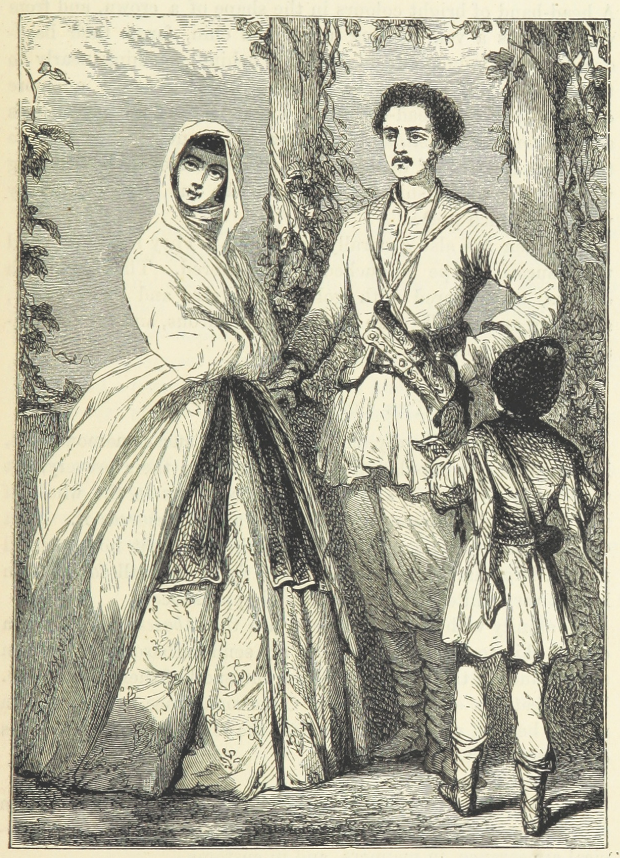
The Georgian Family. 

The Georgian Family is gathered together on the southern slope of the Caucasus. The beauty of the 
Georgian women is proverbial. M. Moynet, in his "Journey to the Caspian and the Black Seas," tells us that they deserve all their reputation. Their physiognomy is as calm and regular as that of the immortal type handed down to us in the ancient statuary of Greece. A head-band of bright colours in the shape of a crown, and from which hangs a veil passing under the chin, forms their headdress. Two long plaits of hair fall behind, reaching nearly to their feet. Nothing can be imagined more graceful or more dignified than this head-dress. A long ribbon of the gayest hues serves them for a sash, and falls down the front of their dress to the ground. Out of doors they wrap themselves up in a flowing white cloth, which shields them from the sun, and which they wear with much grace.

The men are also generally handsome. They have preserved the Caucasian type untouched and unaltered. They wear rich dresses, embroidered with gold and silver, and carry costly, sparkling arms. They are brave and chivalrous, and are passionately fond of horses.

The Mingrelians, inhabitants of Mingrelia, a little kingdom on the shores of the Caspian Sea, resemble the Georgians in physical appearance, in manners, and in customs.

The Circassian Family.

The Circassian Family, collected in the Caucasian mountains, is composed of a population distinguished for their bravery, but very feebly civilized. The Circassian type has in the whole of the East a great reputation for beauty, and it deserves it. Most Circassians have a long oval face, a thin straight nose, a small mouth, large dark eyes, a well-defined figure, a small foot, brown hair, a very white skin, and a martial appearance.

In affinity with the Circassians are the Abases, who speak a dialect akin to Circassian. They are semi-barbarous, and live on the produce of their herds and from the spoil of their brigandage. Their features show no sign of Circassian grace. They have a narrow head, a prominent nose, and the lower half of their face is extremely short.

The Armenians

The Armenians of both sexes are remarkable for their physical beauty. Their language is nearly allied to the oldest dialects of the Aryan race, and their history is connected with that of the Medes and Persians by very ancient traditions. They have a white skin, black eyes and hair, and their features are rounder than those of the Persians. The luxuriant growth of the hair on their faces distinguishes them from the Hindoos.

The climate of Armenia is generally a cold one; but in the valleys and in the plains the atmosphere is less keen and the soil very fertile. Crops of wheat, wine, fruit, tobacco, and cotton are very plentiful there. Mines of gold, silver, copper, iron, and lead are found there, but these are but little worked. Armenian horses have the reputation of being the best bred in western Asia. Cochineal, an important production of this country, is very plentiful at the foot of Ararat. Excellent manna is found in the same districts. Armenian floreals are very abundant.

Armenia nowadays constitutes the pachaliks of Erzeroum, Kara, and Dijar-Bekr in Asiatic Turkey. Besides its indigenous population, it is inhabited by Turks, Kurds, Turcomans, and the remnants of other nations who formerly made raids into their country. The Armenian is distinguished by his serious, laborious, intelligent, and hospitable disposition. He is very successful in business. Fond of the traditions of his forefathers, and attached to his government, he has a good deal of sympathy with Europeans. He becomes easily accustomed to European customs, and learns our languages with little difficulty.


The Christian religion has always been followed in Armenia, and Armenians are much attached to their church. But this is divided into several sects. The Gregorian (the creed founded by Saint Gregory), the Roman Catholic, and the Protestant religions are all to be found in Armenia. The head of the first, which is the most numerous (it musters about four million worshippers), resides at Etchmiadzia, in Russian Armenia. There is another patriarch, who is nearly independent, at Cis, the ancient capital of the kingdom of Cilicia. The patriarch of the Catholics, who are fifty thousand in number, resides at Constantinople; but a second patriarch (in partibus), whose jurisdiction extends over Syria, Cilicia, and a part of Asia Minor, dwells on Mount Libanus. The Roman Catholics of Russian Armenia belong to the see of the Metropolitan residing in St. Petersburg. The head of the Protestant church, which contains from four to five thousand souls, dwells at Constantinople.

The Ossetines

The Ossetines, who are the last branch of the Aryan race in Asia, inhabit a small portion of the chain of the Caucasian mountains, populated for the most part by races distinct from the IndoEuropeans. They resemble the peasants of the north of Russia; but their customs are barbarous, and they are given to pillage. M. Vereschaguine met with the Ossetines in his travels in the Caucasian provinces. A Cossack, with whom he had some trouble, belonged to this race. The villages of the Ossetines lie on the slopes of the mountains. On each side of the Darial Pass lofty walls, flanked by towers, are to be seen, reminding the spectator of the days of brigandage.

The Ossetine, contrary to the customs of all the other tribes of the Caucasus and of the Trans-Caucasus, uses beds, tables, and chairs. He seats himself, like most Europeans, without crossing his legs.

Tuesday, June 28, 2016

James Bryce, Transcaucasia and Ararat (1876)

James Bryce (1838-1922) was a distinguished British jurist, writer and Liberal politician. Born in Belfast, he studied at the University of Glasgow, University of Heidelberg and at Trinity College, Oxford, where he earned his law degree. He practiced law for several years in London before accepting an offer to serve as Regius Professor of Civil Law at Oxford, a position he held for twenty three years until 1893. During this time Bryce had travelled extensively in Europe and, in 1876, visited the Caucasus, where he visited Georgia and Armenia.  In later years Bryce ventured into politics, becoming a member of the Parliament and serving as the British ambassador to the USA in 1907-1913. During World War I he was commissioned to write the well known Bryce Report on the German atrocities in Belgium. 

The brief excerpt below is from Bryce's book "Transcaucasia and Ararat" 


I will shortly describe the chief races that now occupy the country. Beginning from the west, we find the Mingrelians along the Black Sea coast, from the Turkish border to Sukhum Kaleh. They are the ne'er-do-wells of the Caucasian family. All their neighbours, however backward a Western may think them, have a bad word and a kick for the still more backward Mingrelian. To believe them, he is lazy, sensual, treacherous, and stupid, a liar and a thief. The strain in which the Russians and Armenians talk of them reminded me of the description one gets from the Transylvanian Saxons and Magyars of the Wallachs or Roumans who live among them. You ask what kind of people the Wallachs are. "A dirty people," they answer, "a treacherous people, a lazy people, a superstitious people, a cruel people, a gluttonous people. Otherwise not such a bad kind of people."

Lazy the Mingrelian certainly is, but in other respects I doubt if he is worse than his neighbours ; and he lives in so damp and warm a climate that violent exercise must be disagreeable. He is a well-made, good-looking fellow, but with a dull and perhaps rather sensual expression. And he is certainly backward in agriculture and trade, making very little of a singularly rich country. 

South of Mingrelia lies Guria, on the slopes and ridges of the Anti-Caucasus, a land where the people are more vigorous and upright, and where, as they have been less affected by conquest and immigration, the picturesque old costumes have best maintained themselves. 

West of the Mingrelians, in the hilly regions of the Upper Rion and its tributaries, live the Imeritians, a race speaking the Georgian language, who may generally be distinguished by their bushy hair. My personal knowledge of them is confined to three waiters at three several inns, rather a narrow basis for induction, but quite as wide as many travellers have had for some very sweeping conclusions. They have a better name than the Mingrelians, both for industry and honesty, and these three waiters 
were pleasant, civil fellows, though not particularly bright. 

Still farther east, and occupying the centre of Transcaucasia, are the Georgians, called by the Russians Grusinians or Grusians, who may be considered the principal and, till the arrival of the Muscovite, the dominant race of the country. They call themselves Karthli [kartveli], deducing their origin from a patriarch Karthlos (who was brother of Haik, the patriarch of the Armenian nation, and of Legis, the ancestor of the Lesghians), a grandson, or, as others hold, great-grandson of Gomer, son of Japhet. According to their own legends, they worshipped the sun and the moon and the five planets, and swore by the grave of Karthlos until converted to Christianity by St Nina in the fourth century of our era. For several centuries their kingdom extended almost to the Black Sea in one direction and the Caspian in another, and maintained itself with some credit against the hostility of Turks and Persians, though often wasted by Persian armies, and for long periods obliged to admit the suzerainty of the Shah. Its heroic age was the time of Queen Tamara, who flourished in the twelfth century, and is still honoured by pictures all over the country, in which she appears as a beautiful Amazon, not unlike the fancy portraits of Joan of Arc. To her is ascribed the foundation of every ancient church or monastery, just as all the strongholds are said to have been built by the robber Kir Oghlu, and as in Scotland there is hardly an old mansion but shows Wallace's sword and Queen Mary's apartment. [...] One sees traces of a sort of feudal period in the numerous castles ; most of them mere square towers, such as we see on the coast of Scotland and the north of Ireland, which lie scattered all over Georgia and Imeritia ; and the organisation of society was till quite lately feudal, the peasantry villeins under the native kings, and reduced under the Russians to serfdom, while the 
upper class consisted of landowning nobles and their immediate dependants. 

It is a joke among the Russians that every Georgian is a noble, and as the only title of nobility is Prince, the effect to an English ear of hearing all sorts of obscure people, country postmasters, droshky drivers, sometimes even servants, described as being Prince So-and-so, is at first grotesque. The number of noble families is, however, really not very large. I have heard it put as low as thirty, but as the title goes to all the children, each of the families has a vast number of titled members. This at least may be said for the numerous nobility, that, although it has been charged with vanity and frivolity, it does not despise all honest occupations. And some of the Georgian noble houses have pedigrees, apparently authentic pedigrees, older than any to be found in Europe. 

Every one has heard of the Georgian beauties, who in the estimation of Turkish importers rivalled or surpassed those of Circassia itself. Among them a great many handsome and even some beautiful faces may certainly be seen, regular and finely chiselled features, a clear complexion, large and liquid eyes, an erect carriage, in which there is a good deal of dignity as well as of voluptuousness. To a taste, however, formed upon Western models, mere beauty of features and figure, without expression, is not very interesting ; and these beautiful faces frequently want expression. Nor have they always that vivacity which, in the parallel case of the women of Andalusia, partly redeems the deficiency of intelligence. Admirable as pieces of Nature's handiwork, they are not equally charming. A Turk may think them perfection, but it may be doubted whether any one who had seen the ladies of Cork or Baltimore would take much pleasure in their society. However, this is a point on which people will disagree to the end of time; and those who hold that it is enough to look at a beauty without feeling inclined to talk to her need not go beyond Georgia to find all they can wish. It must be remembered, however, that this loveliness is rather fleeting. Towards middle life the complexion is apt to become sallow, and the nose and chin rather too prominent, while the vacuity of look remains. One is told that they are, as indeed the whole nation is, almost uneducated, with nothing but petty personal interests to fill their thoughts or animate their lives.

The men are sufficiently good-looking and pleasing in manner, with, perhaps, a shade of effeminacy in their countenances, at least in those of the lowland. They do not strike one as a strong race, either physically or otherwise, though they have produced some remarkable men, and having obtained civilisation and Christianity in the fourth century of our era, have ever since maintained their religion and national existence with great tenacity against both Turks and Persians. So early as the sixth century, Procopius compliments the Iberians (who are doubtless the ancestors of our Georgians) on their resolute adherence to Christian rites in spite of the attacks of the Persian fire-worshippers, who, it may be remarked in passing, seem to have been the first to set the example of religious persecution. The Muslims say that the Christianity of the Georgians is owing to their fondness for wine and for pork, both which good things, as everybody knows, the Prophet has forbidden to true believers. 
[...]

Scattered through Upper Georgia, and to be found among the peasantry as well as in the towns, there is a considerable Armenian population, who probably settled here when their national kingdom was destroyed by the Seljukian conquerors Alp Arslan and Malek Shah, in the eleventh century. Farther south, in Armenia proper, they constitute the bulk of the population in the country districts, Kurds being mixed with them in the mountains, Tatars in the plains, and Persians in the towns. As I shall have to recur to them in a later chapter, it is enough to remark here that they are the most vigorous and intelligent of the Transcaucasian races, with a gift for trade which has enabled them to get most of the larger business of the country into their hands. Their total number in these countries is estimated at 550,000. Between them and the Georgians there is little cordiality, especially as their wealthy men are apt to be creditors, and the Georgians apt to be debtors. 

Going down the Kur from Tiflis towards the Caspian, one finds the Greorgians give place to a people whom the Russians call Tatars, and who are unquestionably a branch of the great Turkic family....Veritable Turks these fellows certainly are, quite unlike the mongrel race who go by the name of the Turks in Europe, and much more resembling, in face, figure, and character, the pure undiluted Turkman of Khiva and the steppes of the Jaxartes. Being in some districts a settled and industrious race, they are, however, less wild-looking than the Turkmans, and remind one more of the grave and respectable Tatar of Kazan or the Crimea. Their villages, often mere burrows in the dry soil, are scattered all over the steppe eastward to the Caspian, and southward as far as the Persian frontier. Many are agricultural, many more live by their sheep and cattle, which in summer are driven up towards the Armenian mountains and in winter return to the steppe; and some of them, settled in the larger towns, practise various handicrafts, and among others weave rich carpets and other woollen fabrics which pass in the markets of Europe under the name of Persian. The Tatars are also the general carriers of the country. On the few roads, or oftener upon the open Steppe, one sees their endless trains of carts, and more rarely their strings of camels, fetching goods from Shamakha, or Baku, or Tavriz, to Tiflis, thence to be despatched over the Dariel into Southern Russia, or by railway to Poti and Western Europe. 

The last of their occupations, the one in which they most excel, and which they have almost to themselves, is brigandage. To what extent it prevails, I cannot attempt to say, for, as every traveller knows, there is no subject, not even court scandal, on which one hears such an immense number of stories, some of them obviously exaggerated, many of them honestly related, most of them absolutely impossible to test. If we had believed a quarter part of what the quidnuncs of Tiflis told us, we should have thought the country seriously disturbed, and travelling, especially by night, full of peril. If we had gone by our own experience, we should have pronounced the steppes of the Kur a greatdeal safer than Blackheath Common [ an area of south-east London]. Stories were always being brought into the city, and even appearing in the papers, of robberies, sometimes of murders, committed on the roads to Elizavetpol and Erivan; and along the latter road, we found the folk at the post stations with imaginations ready to see a Tatar behind every bush. Even the Russian officials at Tiflis, who of course desired to make little of anything that reflects on the vigilance of the Government, advised us to be careful where we halted, and how we displayed any valuables. I cannot help believing, therefore, that robberies do sometimes occur, and no doubt it is the Tatars, or at least bands led by a 
Tatar chief, who perpetrate them. But the substantial danger is not really more than sufficient to give a little piquancy to travelling, and make you fondle your pistols with the air of a man who feels himself prepared for an emergency. In a dull country, far removed from the interests and movements of the Western world, the pleasure of life is sensibly increased when people have got the exploits of robbers to talk about. It is a subject level with the meanest imagination: the idle Georgian noble and the ignorant peasant enjoy it as heartily as Walter Scott himself. 

[...]

Besides these aboriginal races, Georgians, Mingrelians, Caucasian mountaineers, and Armenians, and the incomers of old standing, such as Tatars and Persians, there is what may be called a top-dressing of recent immigrants from Europe, mostly Russians and Germans. The Russians, with one exception, consist of the officials, who generally consider Russia as their home, almost as our Indian civilians consider England, and intend to return to it when their work is over. The exception is formed by the various sects of dissenters whom the Government, fearing their disturbing political and social influence, has banished, or at least transferred, to these remote seats. They are mostly industrious, well-disposed people, morally, if not intellectually, above the level of the rest of the peasantry, who live in large villages, exactly like those of Central Russia, and keep themselves quite apart from the surrounding native population. 

Still more distinct are the Germans, of whom there are several colonies, the largest, established in Tiflis, numbering some four or five thousand souls. They came hither from Wurtemberg about sixty years ago, driven out by an obnoxious hymn-book. In respect of education and intelligence, they are of course far above any of the natives, while their Protestantism prevents them from intermarrying with, and therefore from sensibly affecting, their Russian neighbours. They have lost, if they ever possessed, the impulse of progress ; their own farms are the best in the country, and their handicrafts-men in Tiflis superior to the Georgians or Persians; but they are content to go on in their old ways, not spreading out from the community, not teaching or in any way stimulating the rest of the population. 

All these races live together, not merely within the limits of the same country, a country politically and physically one, but to a great extent actually on the same soil, mixed up with and crossing one another. In one part Georgians, in another Armenians, in a third Tatars, predominate ; but there are districts where Armenians and Georgians, or Armenians, Georgians, and Tatars, or Tatars and Persians, or Persians, Tatars, and Armenians, are so equally represented in point of numbers that it is hard to say which element predominates. This phenomenon — so strange to one who knows only the homogeneous population of West European countries, or of a country like America, where all sorts of elements are day by day being flung into the melting-pot, and lose their identity almost at once - comes out most noticeably in the capital of Transcaucasia, the city of Tiflis. Here six nations dwell together in a town smaller than Brighton, and six languages are constantly, three or four more occasionally, to be heard in the streets. Varieties of dress, religion, manners, and physical aspect correspond to these diversities of race. 

[...]


These peoples inhabit the more or less level country south of the Caucasus. Besides them, there is a multitude of mountain tribes of whom I have said something in the last preceding chapter, but who are far too numerous and too diverse in their character to be described at length. Probably no-where else in the world can so great a variety of stocks, languages, and religions be found huddled together in so narrow an area as in the Caucasian chain between the Euxine and the Caspian. It is as if every nation that passed from north to south, or west to east, had left some specimens of its people here behind to found a kind of ethnological museum. 

Monday, February 8, 2016

Edmund Spencer, Travels in the Western Caucasus (Part 2) (1838)

Captain Edmund Spencer was a prolific British travel writer of the mid-nineteenth century. Between 1830 and 1850 he traveled widely in Eastern Europe, Middle East and Asia, publishing several travelogues. His first travel book was entitled “Sketches of Germany and the Germans, with a glance at Poland, Hungary, & Switzerland in 1834, 1835, and 1836, by an English resident of Germany” appeared in 1836. Spencer’s second great tour took him down the Danube from Vienna to Constantinople and the Black Sea where he visited the Caucasus; his travelogue “Travels in the Western Caucasus, including a tour through Imeritia, Mingrelia, Turkey, Moldavia, Galicia, Silesia, and Moravia, in 1836” appeared in London in 1838. Spencer continued to travel for the new two decades, including an extensive voyage through the southern Balkans which he described in his two-volume “Travels in European Turkey, in 1850, through Bosnia, Servia, Bulgaria, Macedonia, Thrace, Albania, and Epirus, with a visit to Greece and the Ionian Isles” (London 1851). In 1851 he revisited the Caucasus and spent several weeks traveling through North Caucasus and Western Georgia, publishing his accounts in "Turkey, Russia, the Black Sea, and Circassia (London, 1854).

The excerpt below is from Spencer's book "Travels in the Western Caucasus."


I have already said that we arrived at Kuthaissi [Kutaisi]; prettily situated on the right bank of the Phase [Rioni], and which makes rather a splendid figure when first seen in the distant landscape. But on arriving there, the illusion of its beauty entirely disappeared, for we found nothing but narrow streets and dirty bazaars, nearly blocked up by stalls of every description, from the cobler's and the tinker's to the vendors of cashmere shawls and gold embroidered muslins.

In one place, pyramids of corn and fruit were offered for sale, in another, mutton and sturgeon were being sold by greasy looking fellows to the half-starved, squalid peasants; nor were the weights and scales less noticeable for their novelty, the one being made of wood and ropes, while round stones were employed as a substitute for the others. The greater number of the buildings were nothing better than wretched huts, intermingled here with a low shed as a stable for the cattle, and there with a house, the painted exterior of which denoted that it had seen better days. The owners of these comfortless habitations, for the most part miserable in appearance, were either basking in the sun, or squatted, enjoying the tchibouque [pipe], under a sort of verandah, the shreds of whose tattered canvass awning waved like dirty banners floating in the wind. Such was the aspect of the town, the filth of the streets, and the wretchedness of the inhabitants, their apathy, idleness, slovenliness, with slave imprinted not only on their countenance, but expressed in their whole manner and bearing, that I wished myself back again in the free mountains of Circassia, where every breeze wafted health and vigour, where every man was master of his own actions, where a bag of gold would not procure a night's lodging, but where the stranger, once received as a friend, would be certain of being everywhere treated with the most unbounded hospitality. 

Notwithstanding my unfavourable picture of Kuthaissi, we fared well within its dilapidated walls, having taken up our quarters at the house of an Armenian merchant, who it appears has contrived to amass a considerable fortune by means of his contraband commerce with the tribes of the Western Caucasus. Profuse in his hospitality towards his distinguished guests, he set before us a repast consisting of every delicacy the oriental cuisine could supply, the wily merchant well knowing how much it was his interest to conciliate and flatter the chiefs of a people to whom he was indebted for so large a share of wealth. 

The character of hakkim which I assumed on first entering the Caucasus, with a view of obtaining an insight into the domestic manners of the inhabitants, I found extremely advantageous to me in these provinces, as it ensured me a hospitable reception, independently of my being the guest of a Circassian chief. To the women of the household of the Armenian merchant I administered a few pills, composed of rhubarb and magnesia, which was the means of introducing me into the sanctum sanctorum—the kitchen; and while my patients were mustering courage to engulph the health-giving boluses, I employed myself in taking a sketch of the interior and its multifarious articles.

The tout ensemble differed but little from that in the house of any Circassian chieftain, except that the various culinary utensils were more numerous, and of a more expensive material, being principally composed of copper, and kept remarkably clean. The great variety of dishes that constitute an oriental repast very much surprise a European, and must employ a number of hands in preparing them. Our host, besides his wife and daughters, maintained several female slaves, all of whom, during our stay, were incessantly occupied in their culinary labours. 

Kid, mutton, fish, poultry, game, etc., were the principal ingredients; and these were served in every possible form; neither were they in any degree unpalatable; on the contrary, many would have satisfied even a fastidious European taste. Rice, dates, honey, clarified butter, and fruits of every kind, also entered into the composition of many of their dishes; while thin wheaten or barley cakes, toasted on the embers, or baked in little portable ovens, formed no bad substitute for the white rolls of Europe.

Among the different utensils of the kitchen, my attention was attracted to the hand-mills by means of which they generally reduce their corn to meal, particularly the millet and other light grain. This most primitive mill, found in the house of every inhabitant of the Caucasus, was perhaps the first machine invented by the ingenuity of man at the commencement of the world. It consists of two circular stones, from two to three feet in diameter; the upper one, which has a handle, and an aperture to receive the wheat, is convex in shape, while the lower is concave. Of course the operation of reducing corn to meal by the agency of such a machine is tedious and tiresome, for, as the upper stone must be briskly turned round, the employment is heartily disliked by the women, the most industrious efforts of one strong damsel being insufficient to grind such a supply as will serve for the consumption of a large family in one day. The female slaves, however, take the mill in turn, otherwise the patience of the most patient would be exhausted; as it is, they generally carol as gaily to the monotonous sound of the mill as our own domestics do to the equally monotonous music of their spinning wheels. 

The Armenians are in Asia what the Jews are in Europe—dealers in silver and gold, and are engaged in every branch of trade which does not require manual labour; and, like them, they form an entirely distinct race from the nations among whom they dwell, differing from them in religion, manners, and customs; and also, like the tribes of Israel, their individuality as a people is marked in their physical conformation in characters which cannot be mistaken. In every commercial transaction they exhibit a degree of cunning, shrewdness, tact, and it must be added, selfishness, unapproached by any other people; for if a farthing of profit is to be extracted from a bargain, an Armenian is certain to make it. In these propensities they completely exemplify the Turkish proverb, which says, “A Greek can cheat a Turk; a Jew will dozen a Greek; but an Armenian will trick not only a Jew, but Schaitan (the devil) himself; and where an Armenian is, a Jew must starve.”

During the various invasions of Persia and Turkey by Russia, the Armenians rendered that power, as guides, spies, and agents, the most important services; in return for which, they enjoy many privileges as settlers in the empire, and, as merchants and pedlers, are fettered with few restrictions.

Notwithstanding the ruling passion of the Armenians is avarice, they can be faithful, as they are engaged in preference to any other people by the Circassians as ambassadors to Turkey and Persia, and as guides when they pass through the dominions of the Autocrat. This servile submission to the will of the Circassian knights, I am inclined to think, arises more from fear than attachment or respect, as they well know that, if they break their faith with the inexorable sons of the Caucasus, their whole family would probably be exterminated; for of every other crime in the eyes of that people, not excepting murder, treachery is the most abhorred, and the most severely punished.

[...]

The wife of my host, the fair Kinsha (happiness), who was the daughter of an Abasian usden, had indeed made him happy in a numerous and healthy family; and the merchant might well exclaim, with the Psalmist, “Happy is the man that hath his quiver full of them !” 

The girls were tall for their age, and well made, their figures being sufficiently round without approaching embonpoint; their fine eyes, large and sparkling, gave an intellectual expression to their countenances, while their pearly teeth, and the smile of good humour that played about a mouth regular in its lines as that of Canova's Venus, much improved their personal attractions. Their complexion was much darker than that of the mountaineer of the Caucasus, and might resemble that of a Spanish brunette. Like all orientals, they manifested a decided predilection for finery, in the number of gold ornaments which decorated their hands, fingers, and ears. Their dress was similar to that of the women of the Caucasus, the Circassian princesses being the standard of feminine taste in this part of the east, — full trousers, of bright-coloured Indian cotton, and a large silk wrapper, confined by a girdle studded with gold or silver ornaments, which exhibited their forms to great advantage. 

Although the Armenian women in Turkey generally appear in public closely veiled, and in their houses are seldom visible to strangers, those of our merchant were by no means rigidly excluded from society; they were also more familiar, talkative, and curious, than the Caucasian women in general, while their manners seemed a mixture of the Russian and oriental, and they only wore the veil when taking a promenade. 

The slaves of the household appeared to be treated with as much kindness and consideration as the domestic servants in a well-ordered family in Europe; for an interesting young girl, who was in the last stage of a consumption, was brought to me for my opinion, and as much anxiety was manifested with respect to her recovery as if she had been the only child of the family, for, when I informed them that no earthly power could save her life, the whole of the women burst into tears, and exhibited the most violent demonstrations of sorrow. 

The house of our Armenian was furnished with a greater regard to show than neatness; the sofas and divans of the principal room were covered with rich silks, the floor with Persian carpets, and the walls were hung with purple velvet. Instead of the paintings of saints and angels, such as we see in the houses of those professing the Greek and Roman-catholic form of worship, sentences from the Bible, wrought in gold characters (in the Armenian language), on a ground of the same coloured velvet, were suspended round the room. At table we were furnished with chairs, knives, forks, and spoons,—an arrangement which sadly annoyed my friends the Circassians, who had never before made use of them, and were not a little astonished on observing my adroitness in handling these, in their opinion, very unnecessary appendages to a meal. There was a still greater degree of pomp observed in serving the coffee, which was poured into the finest porcelain cups, resting on gold filigree stands, and then placed upon a massive tray, richly gilt and ornamented. 

All this splendour, however, made no impression upon the sturdy mountaineers, who despised it as useless parade and ostentation, fit only for an effeminate Turk or Persian, or a contemptible money-getting merchant. My friend, the grave austere Inal, denounced it as the origin of every crime, as the certain indication of a state of slavery ...

Saturday, January 23, 2016

Sir Justin Sheil, Glimpses of Life and Manners in Persia (1856)

Sir Justin Sheil (1803–1871) was a British general and diplomat, who had spent much of his career in the service of the British East India Company. Born in Britain in 1803, he was educated at Stonyhurst and joined the 3rd Bengal Infantry in 1820. He spent the next thirteen years in India before being sent to represent the Company interests in Persia. In 1836 he was appointed secretary to the British legation in Persia, and in 1844 he succeeded Sir John McNeill as envoy and minister at the shah's court. He held this until his retirement in 1854. While in Persia (as well as traveling through Russia and the Ottoman Empire), Sheil kept a detailed journal that his wife later edited and published under the title of "Glimpses of Life and Manners in Persia" (London: John Murray, 1856).


Tiflis is another Vladikafkaz (key) on the southern side of the Caucasus. We were glad to arrive at this capital of the Transcaucasian provinces, which is close to the foot of the mountains, and situated on both sides of the river Kur. Some sixty years ago it was sacked by the Shah of Persia, Agha Mahommed Khan, the founder of the dynasty of Kajar, who carried a large portion of the inhabitants, Georgians and Armenians, into slavery. I saw at Tehran a few of these unhappy captives, who all had been forced to embrace Mahommedanism [Islam], and many of whom had risen to the highest stations; just as the Circassian slaves in Constantinople became pashas, seraskiers, capitan-pashas, &c. 

Tiflis has entirely recovered from this shock. It is now a most thriving, active, and bustling city, and will doubtless, when the day arrives for the development of free trade in the dominions of the Czar, become a rich emporium of commerce, situated as it is midway between the Black Sea and Caspian, and on the high road between Russia, Persia, and Asia Minor. The official part of the town is full of imposing buildings, and the native portion is equally well stored with busy shops,crowded by the motley population. Prince Woronzow's fostering care has not allowed this important part of the territory under his jurisdiction to remain without its share of his patronage. In spite of the pre-occupation of a war, not always successful, with the mountaineers, he is said to have planned many valuable institutions, to which are to be added a large and handsomely built theatre for the performance of operas, not completed at the time of our visit, besides a small theatre, for Russian comedies and farces. All these improvements evince his anxiety to promote civilization among the Georgians and Armenians. The Military Governor of Tiflis was an Armenian of Georgia, General Baibetoff [Vasili Bebutov]; a man of experience, who had distinguished himself in the campaigns of Turkey and Persia in former years. It sounded strange to find an Armenian occupying this high post, but Russia is more cosmopolite than England. A stranger of the gate is readily admitted within the temple; but it will require a change in English ideas before we find a Canadian or Maltese Governor of India, or the Cape of Good Hope. Is this facility the result of enlightenment, or does it proceed from the dearth of native talent?

If I were to form my opinion from the Georgian ladies visible in the street, which, except one evening that we went to the theatre, was the only place I had an opportunity of beholding them, I should be forced to declare that their beauty has obtained a greater reputation than it deserves. They certainly are fair, with high complexions, natural or artificial, and regular features, all of which perhaps entitle the owners to the meed of beauty; still the entire absence of animation or expression deprives the countenance of attraction. They look well, however, in their pretty dresses while young. The Armenians, when out of doors, wrap themselves up in white veils, or rather cloaks, which have a graceful effect.

At Tiflis we were lodged, as usual, at the house of an Armenian merchant. He was a man of much reputed wealth. His house was furnished with great richness, and at a cost that may be imagined when it is considered that the whole of the furniture was brought from St. Petersburg. It was much too expensive to be profaned by use, being exclusively reserved either for compulsory guests, like ourselves, or marriage and other feasts. The part of the habitation occupied by our host and his family was very humble, and far from clean.

Next to its conquerors [Russians], the Georgians are the master caste of this country. It is said that between the Georgians and the Armenians, who are found here in great numbers, there is a wonderful contrast in character and manners. The Georgian is bold, turbulent, reckless, extravagant; the Armenian is mean, cringing, timid, always intent on gain, and, unlike a Georgian, in keeping what he gains. The same characteristics mark him in Persia and Turkey, and I am told everywhere else; for, like the gipsy, he is a wanderer on the face of the earth, and is to be found in every part of Asia. He is consequently an abundant and pleasant harvest to all needy pashas, khans, hakims, and minor functionaries of misrule, easily reaped, gathered, and gleaned.

It is as unsurpassable topers [drinkers], as well as for their military qualities, which have always been acknowledged, that the Georgians have acquired notoriety. At their frequent drinking parties it is said they will pass several days and nights, almost without intermission, in quaffing the productions of the vineyards of Kakheti, a district in the mountains east of Tiflis. This wine is by no means of bad quality; it is of a deep red colour, so deep that one fancies it has been tinged with some dye to produce so intense a hue. They are said to consume incredible quantities of wine on these occasions, and in a fashion that would put to shame the drinking triumphs of Ireland, recorded by Sir Jonah Barrington, in days of old, when intoxication was the standard of spirit. The drinking-vessel is a cow's horn, of considerable length, and the point of honour is to drain it at a draught. The brethren and convivial rivals of the Georgians in the neighbouring provinces of Imeretia and Mingrelia, instead of a horn, use a delicately-hollowed globe of walnut tree, with a long narrow tube at the orifice. It holds fully a pint, and like its companion, the horn, the contents are consumed at a single gulp. How these globes are hollowed is as great a marvel as the construction of the ingenious Chinese puzzle of ball within ball.

[...]

Traveling in Georgia is neither luxurious nor commodious, still it immensely surpasses all our experience of Southern Russia, particularly in the Mahommedan [Muslim] portion of the province. If horses were scarce at the post-houses, chickens and lambs, yoghourt and kymak, those savoury preparations from milk so cherished all over Asia, were abundant. The invasive hordes of the post-houses, too, we heard, were less numerous, ferocious, and bloodthirsty, but we pressed on without stop or stay through a pretty country with groves of oak-trees scattered about, which afforded food for enormous droves of swine, in whose flesh the Georgians take special delight. When we arrived at the high mountains near the lake Gookcha, we left our carriage and walked up the pass. On reaching the summit of this high range, which forms the limit of Georgia proper, we had a noble prospect. On the left, at our feet, lay the beautiful lake of Sevan, the first sheet of water we had seen on this journey; before us were spread Armenia and the plains of Erivan, expanding far to the south; while on the right, dark, towering, and frowning, lay the Karadagh, the Black Mountains, beyond Kars, stretching towards the Black Sea. At this interesting spot the postmaster had hospitably resolved not to confine our gratification to the pleasure of sight, and had prepared for us a most notable breakfast; at which we reveled on strawberry jam, made fresh from the fruit on the mountains, and the far-famed salmon trout, just out of the lake. Long after dark, at the conclusion of a toilsome journey over a detestable road, we reached Erivan....

[After visiting Armenia and spending time in Persia, Sheil and his wife travelled through eastern Ottoman Empire on his way to Istanbul. Along the way he encountered the Laz people]
The Turk of Trebizond is a very different person from the genuine Osmanli. The distinction is so visible and so great, as to create a strong belief of his being a Greek in disguise—the descendant, in short, of the old Greek population. Though affecting to be real Osmanlis, that is, the offspring of the Turkish invaders, collected together by the house of Osman, they are by the latter called Laz, that being the name of the population between Trebizond, Batoon, and Gooriel. I am informed that the Laz are probably allied in race with the Mingrelians and Imeretians, to whom they are said to bear a resemblance in dialect. 

Among the real Turks their reputation is low, to be called a Laz being held as a term of reproach equivalent to an imputation of a want of faith, honour, or religion. A Laz, as a Turkish proverb says, will at any time " kill a man for an onion." There cannot be a greater contrast than that between the "Trebizanli" Laz, or Greek, and the lazy fanatic Turk of Erzeroom, laden with conceit and ignorance. The native of Trebizond is said to be full of activity and energy; he is cheerful and lively; unlike everything Turkish, he puts his gun on his shoulder and trudges over the mountains in quest of game. Still more curious and un-Turkish, you meet him on Friday with a party of his comrades, sauntering amid the beautiful environs of his native city, accompanied by a fiddler and singer, with whom he does not disdain to join in chorus. It is suspected that on these occasions the merrymakers are supported by something which gives inspiration to the fiddle and song.

Thursday, April 23, 2015

John Fryer, New Account of East-India and Persia (1698)

John Fryer (d. 1733) was English doctor and traveler who had visited Persia and wrote insightful memoir on his experiences. The eldest son of William Fryer, he graduated from the Trinity College in Cambridge in 1664 and later studied medicine at Pembroke College in Cambridge. After completing his studies he was appointed as a surgeon to the East India Company and sailed to India in 1672. He spent the next eight years traveling across India and Persia, publishing his observations in  "New Account of East-India and Persia, in Eight Letters" in 1698. Although Fryer's travelogue fails to rival those of his other contemporaries Jean Chardin, Jean-Baptiste Tavernier or François Bernier, it still contains many interesting observations on society, politics and natural history. 

In Letter V of his book, Fryer turns his attention to the Georgians he had encountered in Persia and below are his observations (original orthography retained).


The next neighbors, if not the same with the Armenians, were the Iberians, now called Georgians, who underwent the same calamities [Persian invasions and resettlements of the early 17th century] with them; but with a contrary disposition of Humour [state of mind], being a Martial People bred up to the Wars, [Georgians] now serve the Emperor [shah of Persia] as his best Infantry; of these, Forty thousand are at present in Arms under Military Pay, in and about Spahaun [Isfahan]. Their Country at this time bears the name of Gurgestan, from whence they are Christen'd Georgians; not from the famous St. George, but because they follow Husbandry [agriculture]. They were converted to the Christian Faith near the same time with the Armenians; which they still retain, and maintain their State and Country; but both Christianity and their Country are past their Vertical Point, and are upon their Declension [decline].

[Georgian] Princes , to uphold their Prerogative, are inclined to submit to the Persian Yoke with the Ignominy of Apostatizing, rather than by a stout defiance resist the Temptations and Allurements of Government under the Mahometan Bestiality: Such Power has the Ambitious Thirst of Rule.

[Georgians] are Proper, Fresh-colour'd, Well-limb'd People: Their Women so Fair and Beautiful, that the [Persian] Queen-Mother is always of the Family of the Georgian Princes; and for that reason is it their Children are so often sold to Infidels, because they make good Markets of them. Mars [God of War] has the Ascendent over this Nation, as Mercury [Patron of Commerce] has over the Armenians. There is therefore an inveterate Contrariety of Tempers between humour [states of mind] from them; and since the Armenians deserted the Greek Church, this Breach is widen'd ; being impatient at the performance of each others Services in the Churches, the Georgians frequently interrupt them in their Devotions, and doing despite to their Altars on their most Public Solemnities: Such Absurdities does Religion introduce, which should be the only means to cement and unite Mankind in the Bond of Humanity.

The Blame whereof must chiefly lye at the doors of their Prelates , whose obstinacy and Perverseness, abdicating all Force of Reason, are guided by no other impulse than the present Enjoyments of this Life , and keep on foot particular Piques and Animosities, purposely to distract and vex the Church, thereby to carry on their own interest or Ambition; Otherwise, how should it come to pass that those baptized under the same Symbol, and in many ( and the most difficult) Points of Religion are agreeing, should not be all of one Mind in every respect, unless the Idle Dreams and Malicious Practices of the Inorthodox should inculcate Debates and sow Divisions, only to be Head of a Party? 

Tuesday, February 24, 2015

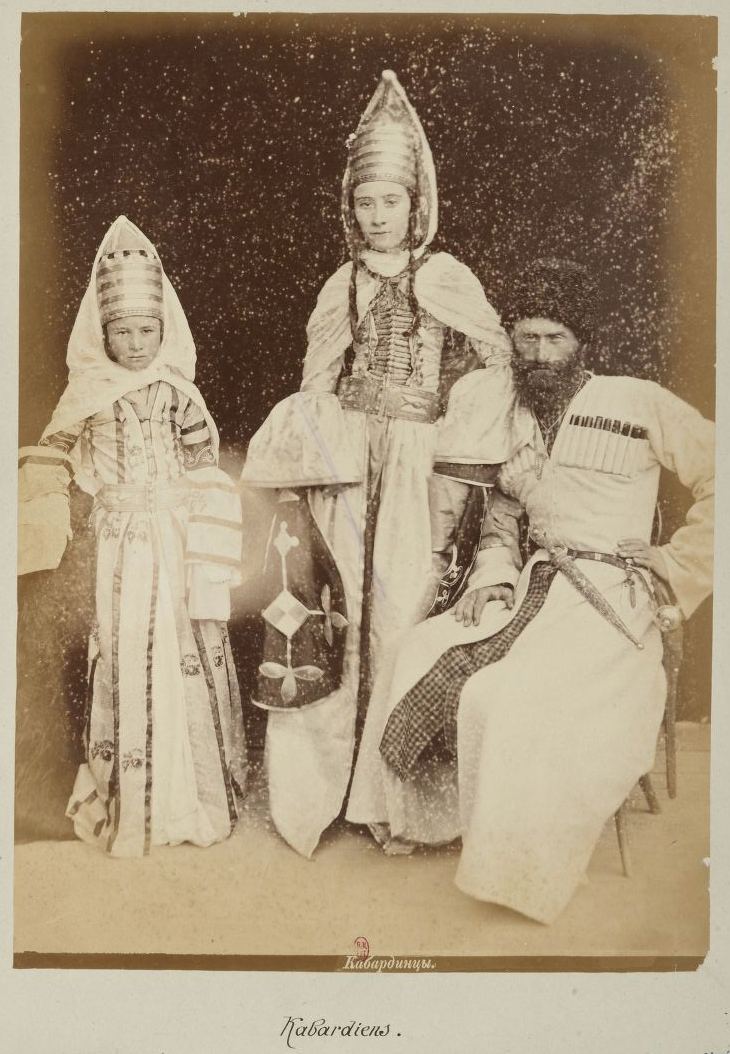
Ernest Chantre, Mission scientifique... dans la Haute Mésopotamie, le Kurdistan et le Caucase (1881)

Photographs taken by Captain Barry during Ernest Chantre's expedition to the Caucasus in 1881. They were eventually published in Mission scientifique de Mr Ernest Chantre, sous-directeur du Museum de Lyon, dans la Haute Mésopotamie, le Kurdistan et le Caucase. VI, Caucase. Arménie, Géorgie, Osséthie, etc. (Paris, 1881).